
R.E
Intention
What are we trying to achieve?
At St. Benedict’s Primary School, Religious Education inspires children to become curious, respectful and reflective learners. Through learning about and from a range of religious and non-religious worldviews, our children develop understanding, empathy and the confidence to thrive in our diverse society.
We are proud to hold the Silver RE Quality Mark, alongside our Rights Respecting Gold Award and School of Sanctuary accreditation, recognising our commitment to providing an inclusive, high-quality Religious Education curriculum for every child.
St. Benedict’s Primary School is a Rights Respecting School and the United Nations Convention on the Rights of the Child is at the heart of everything we do.
“Enjoying our rights and fulfilling our dreams.”
We believe that by understanding their own rights, children learn to respect and value the rights of others.
We aim for our children to be:
- Ambitious – to have a strong desire to achieve.
- Resilient – to have the ability to withstand and bounce back from difficult life events.
Respectful – to behave in a way that shows care for their own rights and the rights of others, the local and global community and the environment.
The following articles underpin our aims:
Article 3
“The best interests of the child must be a top priority in all our actions.”
Article 29
“Education must develop every child’s personality, talents and abilities to the full. It must encourage the child’s respect for human rights, as well as respect for their parents, their own and other cultures and the environment".
Religious Education aims to develop pupils’ spiritual, moral, cultural, mental and physical development, preparing them for a future in society.
The Birmingham approach is designed to be inclusive of all children across our super-diverse city, enabling every child to be respected and understood. The syllabus includes the nine religious traditions that have significant representation within Birmingham: Bahá’i, Buddhism, Christianity, Hinduism, Islam, Jainism, Judaism, Rastafari and Sikhism, as well as established non-religious worldviews such as Atheism, Humanism and Secularism.
At St Benedict’s Primary School, RE promotes pupils’ spiritual, moral, social and cultural development. Children learn about and from religious and non-religious worldviews; they learn from experience, and they learn to discern (critically evaluate).
We strive to enable pupils to:
- Develop their spiritual, social, moral, cultural, mental and physical well-being.
- Reflect on their experiences, beliefs and values.
- Develop the ability to make reasoned and informed judgements about religious and moral life.
- Develop positive attitudes towards other people, respecting their right to hold beliefs different from their own and enabling them to live in a world with many diverse religions and non-religious worldviews.
- Develop knowledge and understanding of the faiths, practices and values of the religious and non-religious traditions found in Birmingham and elsewhere, and their influence on individuals, families, communities and society.Experience the significance of religion within our community through a range of activities, including meeting people, sharing experiences, listening to stories and music, and appreciating different art forms.
- Experience and understand a range of approaches to life.
- Develop the skills needed to live in a world where people are respected and valued.
Implementation
How do we organise this?
There is a statutory requirement placed upon schools to provide a basic curriculum. This consists of the National Curriculum and the locally agreed syllabus for Religious Education. The statutory requirement entitles all pupils in Birmingham, irrespective of their social background, culture, race, religion, gender, ability or disability, to a high-quality programme of teaching and learning in Religious Education.
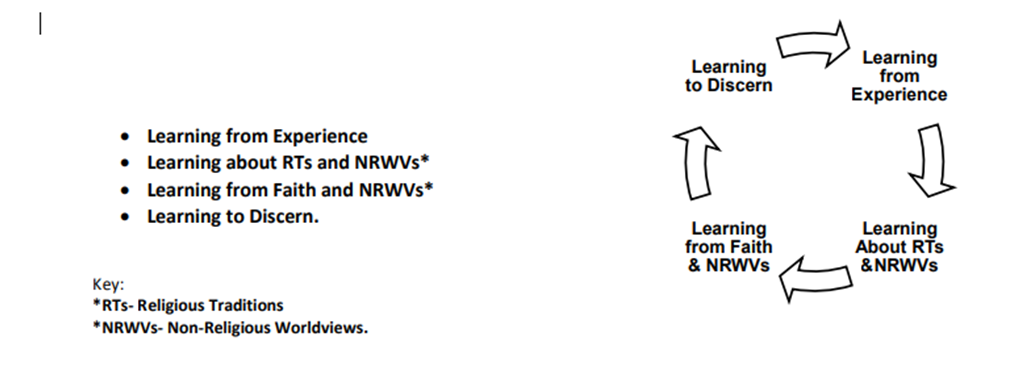
The syllabus is organised around a learning model that explores the 24 dispositions through four tangible, interconnected aspects:
- Learning from Experience
Effective Religious Education takes account of pupils’ experiences and backgrounds. Children come to RE with a wide variety of experiences, including those from religious backgrounds, those with a background in organised non-religious worldviews, and those who do not identify with either religious or non-religious worldviews, often referred to as the ‘nones’.
Each disposition is introduced by exploring what pupils already know about the concept through their own experiences. This approach is particularly inclusive because it values and draws upon the wide range of perspectives represented within the classroom. It also addresses the fact that some pupils who do not identify with a religious or non-religious worldview may initially find it difficult to relate to religious or worldview content if they do not see its relevance to their own lives. While some pupils may have a personal philosophy or ideology on which they wish to reflect, every child brings valuable experiences that can be used to deepen understanding. Learning from Experience therefore provides a powerful and universal foundation from which pupils can explore the other dimensions of each disposition.
-
Learning about Religious Traditions and Non-Religious Worldviews
In Birmingham, Religious Education is open, inclusive and represents diverse convictions in a fair and honest manner that is accessible to all. As pupils approach successive Key Stages, they will have the opportunity to learn about a growing range of different religious traditions and nonreligious worldviews, the balance and selection recognising that Christianity is the predominant faith in the country. Pupils will acquire knowledge of religious traditions and non-religious worldviews enabling an understanding of their own faith or established view and those of others.
- Learning from Faith and Non-Religious Worldviews
Pupils are supported to reflect on their own beliefs, values and experiences so that they can learn how to live well. Developing as a whole person involves intellectual, emotional and behavioural growth, sometimes referred to as developing cognitively, affectively and conatively.
Intellectually (or cognitively), pupils develop by:
-
- Developing knowledge and understanding of religious traditions and non-religious worldviews.
- Evaluating and reflecting on these in the light of their own experiences.
- Developing informed judgement.
Emotionally (or affectively), pupils develop by:
-
- Deepening their feelings and understanding.
- Acknowledging and responding to shared human experiences, such as joy, grief, thankfulness and care.
- Expressing personal reflection, including spiritual or religious responses, through words or other forms of expression.
- Behaviourally (or conatively), pupils develop by:
- Being encouraged to act responsibly.
- Cultivating widely recognised values and virtues, such as honesty and integrity.
- Being motivated to act upon their newfound understanding.
4. Learning to Discern
By learning to critically interpret and evaluate the content they encounter, pupils develop their ability to discern. They are encouraged and challenged to reflect, evaluate and think critically about what they have learned. This develops reflective and interpretative skills while enabling pupils to examine their own thinking in the light of new knowledge and understanding.
Religious Education is a statutory part of the curriculum. Our curriculum is carefully sequenced from the Early Years Foundation Stage to Year 6, enabling children to revisit and deepen their knowledge, understanding and skills over time. This ensures that all pupils receive a broad, balanced and progressive Religious Education.
It is recommended that Religious Education is taught for 36 hours each year in Key Stages 1 and 2. At St Benedict’s Primary School, every class in Key Stages 1 and 2 receives at least 40 minutes of RE each week.
Teaching is carefully planned to ensure lessons are stimulating, engaging and inclusive, enabling all pupils to access a high-quality Religious Education curriculum. Lessons are carefully adapted to meet the needs of all learners, including children with SEND and those learning English as an Additional Language (EAL), ensuring that every child can succeed.
In Key Stages 1 and 2, children participate in lessons with a strong emphasis on speaking and listening, developing skills such as discussion, conversation, teamwork and collaborative thinking. Learning is enriched through role play, music, storytelling, video clips, artwork, creative writing, high-quality texts, religious artefacts and photographs, providing pupils with engaging and meaningful learning experiences. Resources from the Birmingham Agreed Syllabus further enrich learning and support progression.
In the Early Years Foundation Stage, children begin exploring festivals, celebrations, and religious and non-religious worldviews through the areas of Understanding the World and Personal, Social and Emotional Development. These experiences provide strong foundations for future learning in Religious Education.
The 24 Dispositions
Children’s learning within the Birmingham Agreed Syllabus for Religious Education is guided by 24 dispositions. Taken together, these dispositions contribute to the development of a child’s spiritual and moral character and help to portray the qualities of a well-rounded individual.
The 24 dispositions are organised into six key clusters:
|
Creativity
|
Compassion
|
|
Choice
|
Community
|
|
Commitment
|
Contemplation
|
Festivals and Enrichment
To enable children to develop a holistic appreciation of different religions, we teach a range of important religious festivals alongside the Birmingham Agreed Syllabus. These include:
- Christmas
- Easter
- Eid
- Harvest
- Diwali
- Chinese New Year
- Holi
- Vaisakhi
Children’s learning is enriched through:
- visits to places of worship (KS2);
- opportunities to meet members of different faith communities;
- celebration of major religious festivals;
- exploring religious artefacts;
- stories, music, artwork and high-quality texts;
- links with our Rights Respecting work and wider community learning where appropriate.
Our accompanying photographs showcase many of these enriching experiences and provide a snapshot of Religious Education in action at St. Benedict’s Primary School.
Collective Worship
Collective Worship provides an opportunity for the whole school, or groups within the school, to come together to reflect on shared values, common concerns, important issues and significant events. It offers all pupils opportunities to engage in meaningful experiences that support their spiritual, moral, social and cultural development.
At St Benedict’s Primary School, we fulfil this through:
- Celebration assemblies, where children’s achievements are recognised, celebrated and valued.
- Leadership assemblies, which promote moral development and explore significant religious and cultural festivals throughout the year.
- Rights Respecting School work, which underpins all aspects of school life and supports children in developing their moral awareness, understanding of rights and responsibilities, and respect for others.
- The celebration of a wide range of festivals, enabling children to reflect on their own cultural and spiritual beliefs while developing an appreciation and understanding of the beliefs and traditions of others.
- Incidental discussions within the classroom, where pupils are encouraged to reflect on current events, moral issues and their own experiences.
- Pupil leadership opportunities, including the School Council, Eco Committee and other leadership roles, which encourage responsibility, teamwork and active citizenship.
Impact
How do we know it is successful?
RE offers our children the means by which to understand how other people choose to live and why they choose to live in that way. As such, RE is invaluable in an ever-changing world. During pupils’ first few years in school, they are progressively introduced to the 24 dispositions. Subsequently, they revisit all 24 dispositions with increasing depth, enabling a growing sophistication of spiritual and moral character, disposition by disposition, alongside an increasing knowledge of religious traditions and non-religious worldviews.
Children enjoy learning about different religious and non-religious worldviews and are able to make meaningful links between their own lives and those of others within their community and the wider world. RE acts as a hub between social aspects of learning, Science and Geography. Through RE, our children develop an understanding of other people’s cultures, customs, experiences, beliefs and ways of life, which they are then able to communicate to the wider community.
At St Benedict’s Primary School, we aim to develop Successful Learners who enjoy learning, make progress and achieve; Responsible Citizens who are self-assured and socially aware, who have pride in their own history and heritage and respect that of others; and Confident Individuals who are able to live safe, healthy and fulfilling lives. RE makes a significant contribution to achieving these aims.
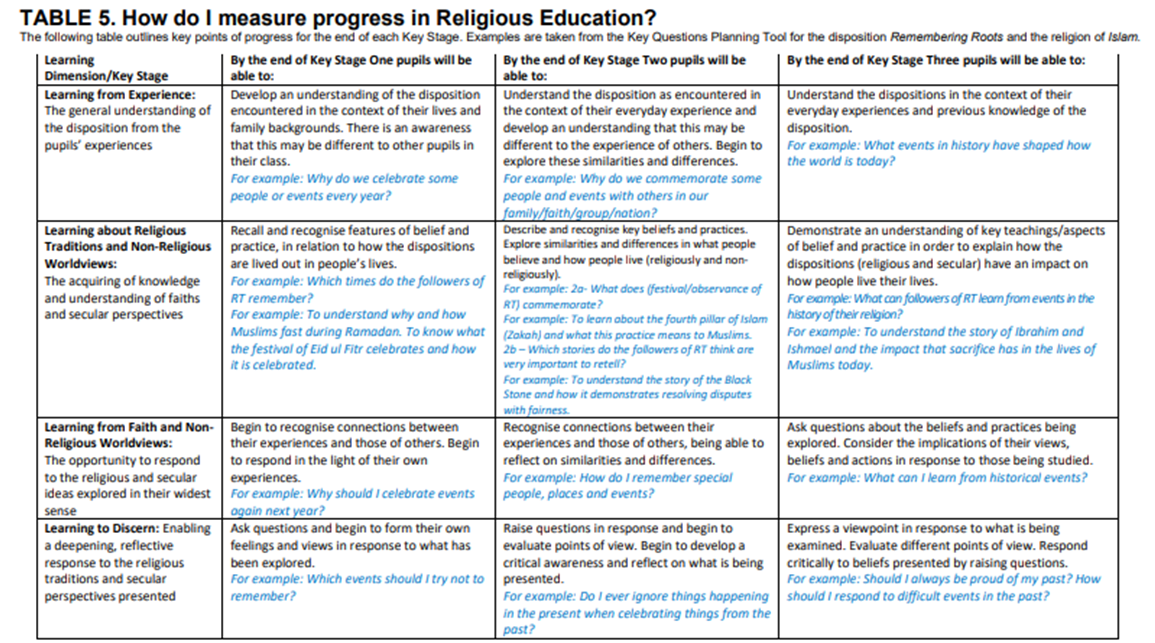
As children move through the school, there is a clear progression of knowledge, understanding and skills, alongside a broadening of Religious Education knowledge. In the Foundation Stage, children begin to learn about some of the major religious festivals and some of the main religions represented in the United Kingdom. As they progress through Key Stages 1 and 2, they revisit the 24 dispositions in increasing depth, deepen their understanding of religious and non-religious worldviews, and become increasingly confident in discussing, comparing and evaluating different beliefs and practices.
Example of Progression
Assessment
There is currently no statutory assessment for Religious Education.
Teachers assess children’s understanding through enquiry questions, discussion, observations and pupils’ recorded work. Progress is evidenced through Learning Journals in EYFS, RE portfolios in Key Stage 1 and individual workbooks in Key Stage 2.
The RE Subject Leader monitors Religious Education through planning reviews, lesson observations, pupil voice, teacher voice and scrutiny of Learning Journals, portfolios and workbooks. Assessment is used to inform future planning and ensure progression across the school.


